John Harrison, the Man Who Taught the Sea to Tell Time

The story of the craftsman who turned horological precision into a new way of finding our place in the world.
For centuries, sailing into open water meant accepting a radical form of uncertainty: far from the coast, a captain could know his latitude, but not precisely how far east or west he had travelled. Solving that mystery demanded more than astronomy. It required a clock capable of keeping time amid the motion of the sea. John Harrison, a carpenter by training and a clockmaker by vocation, devoted his life to building one.
The Sea as a Problem
At the beginning of the eighteenth century, the ocean remained a territory without landmarks. The position of the sun made it relatively easy to calculate how far north or south of the equator a ship had sailed. Longitude was another matter. An error was not a mathematical abstraction: it could turn a voyage into shipwreck, disease and death.
The wreck of Admiral Cloudesley Shovell’s squadron in 1707 revealed the scale of the problem. Four Royal Navy ships struck the Isles of Scilly because their captains believed the rocks lay many miles away. Nearly two thousand men died. Years later, Admiral George Anson would lose much of his crew while searching for Juan Fernández Island: he knew the correct latitude, but not whether the island lay east or west of his position.
The solution was hidden in an equivalence as simple as it was difficult to apply: time and longitude are two expressions of the same measure. The Earth turns through 360 degrees in twenty-four hours; one hour of difference corresponds to fifteen degrees of longitude. If a navigator could compare local time—read from the position of the sun—with the exact time at the port of departure, he could determine where he was.
The challenge was not to understand the formula, but to make a clock remember the time at home after weeks of shocks, humidity and changing temperatures.
In 1714, the British Parliament passed the Longitude Act and offered up to £20,000 for a practical method of determining longitude at sea. The reward, extraordinary for its time, attracted proposals that ranged from ingenious to outlandish and sometimes delusional. In the popular imagination, the quest became associated with madness. While astronomers hoped to turn the Moon and stars into a celestial clock, a craftsman in Lincolnshire began to imagine a mechanical answer.
A Carpenter Who Thought Like an Engineer
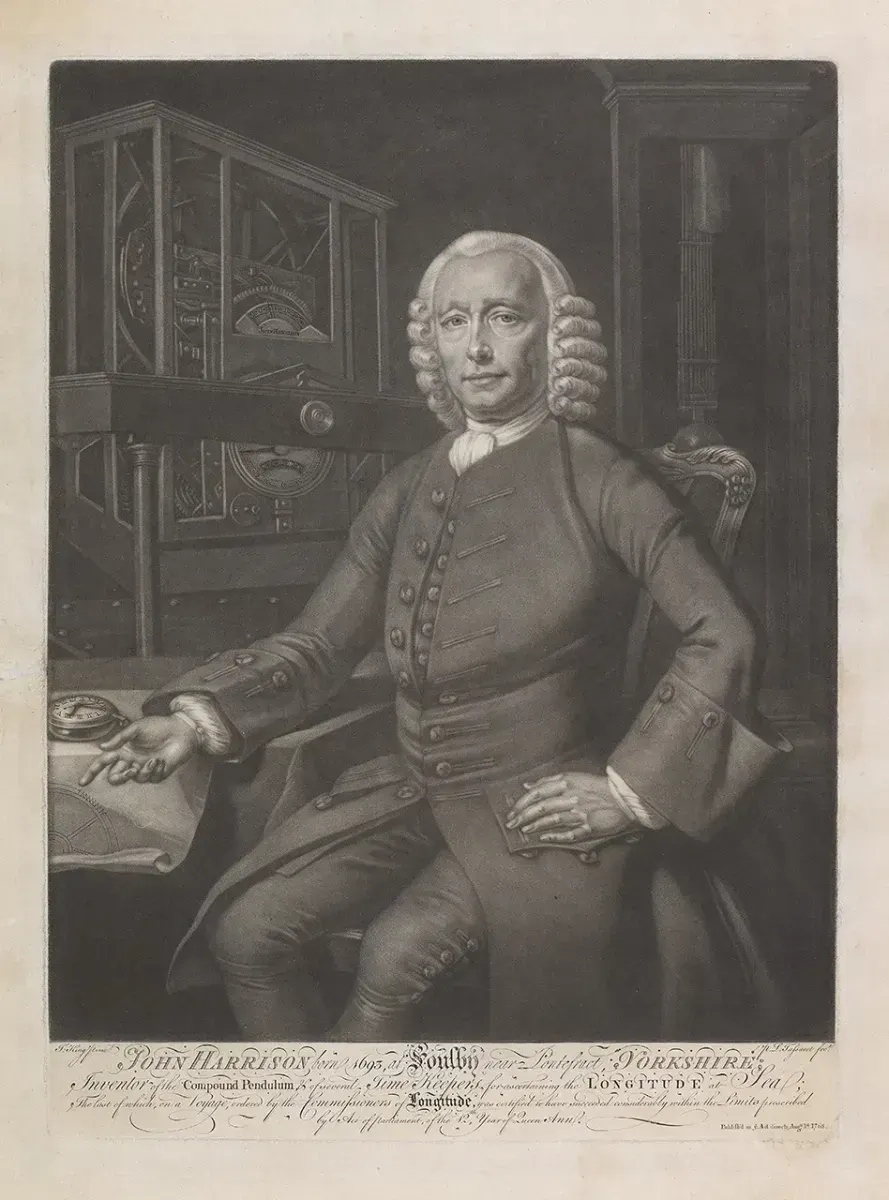
Little is known of John Harrison’s youth. He learned carpentry from his father and built his first clocks almost entirely from wood. By the age of twenty, he was already working oak and boxwood with exceptional precision. He selected each cut, aligned the grain to reinforce the teeth of the wheels and made joints whose quality still astonishes three centuries later.
His real gift, however, was not simply making things well. Harrison observed every source of error and turned it into a design question. Friction, the need for lubrication, the expansion of materials and an uneven driving force were not unavoidable inconveniences: they were problems that could be solved.
The turret clock he built around 1722 for the stables at Brocklesby Park marked his transformation from accomplished local clockmaker to inventor. He combined lignum vitae bearings with brass to reduce friction, then developed the grasshopper escapement, a mechanism in which the pallets receive direct impulses and move away from the wheel without the usual sliding action. The result needed almost no lubrication. The clock still runs at Brocklesby and keeps remarkably good time—perhaps the finest proof that durability can also be a form of intelligence.
In his regulators of the 1720s, Harrison added a temperature-compensated pendulum made from a grid of brass and steel rods. Because the two metals expand at different rates, he arranged them so that the effective length of the pendulum remained stable. He claimed an error of barely one second a month, far surpassing the best London clocks of the period.
Four Machines Against the Ocean
When Harrison arrived at the Royal Observatory in Greenwich with plans for a marine clock, the astronomer Edmond Halley realised that he needed the opinion of a mechanical expert and sent him to George Graham, London’s most distinguished instrument maker. The meeting began with suspicion and ended, ten hours later, with encouragement, support and a loan. It was the backing Harrison needed to build H1.
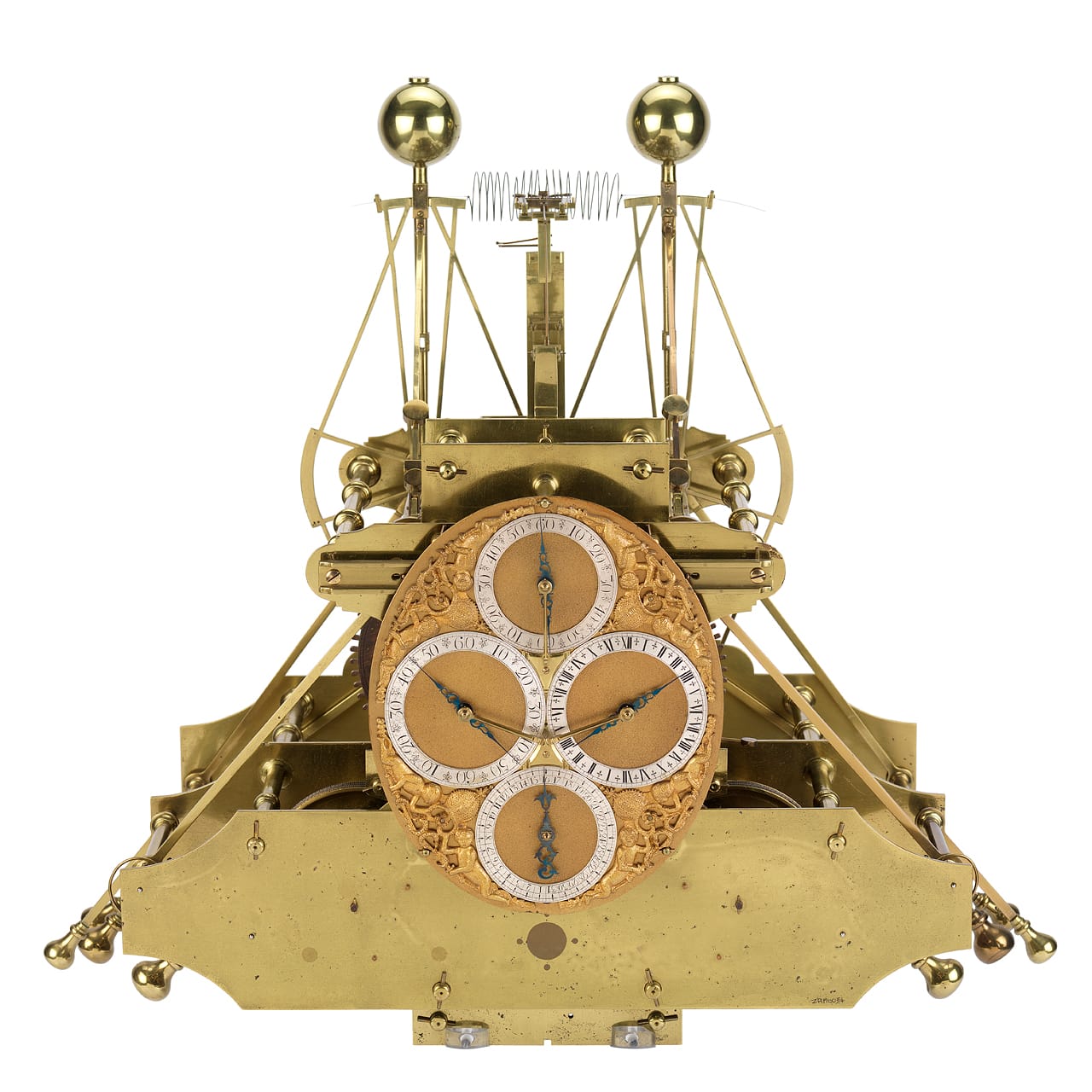
Completed in 1735, H1 looked more like an experimental machine than a clock. It dispensed with the pendulum, useless aboard ship, and used two bar balances connected by crossed ribbons. Powered by springs, it incorporated the grasshopper escapement and many of the anti-friction solutions from Harrison’s wooden clocks. On a trial voyage to Lisbon, the mechanism struggled on the outward passage but performed far better on the return. Near the English Channel, H1 corrected the officers’ estimated position and helped prevent the ship from running aground.
H1 was not yet accurate enough to claim the prize, but it persuaded the Board of Longitude that the idea was viable. Harrison received funds to continue. In H2, he replaced the wooden wheels with bronze and introduced a remontoire, a small mechanism that regularised the force delivered to the escapement. Harrison then discovered that the bar balances were vulnerable to a ship’s movement and chose not to submit the machine for an official trial.
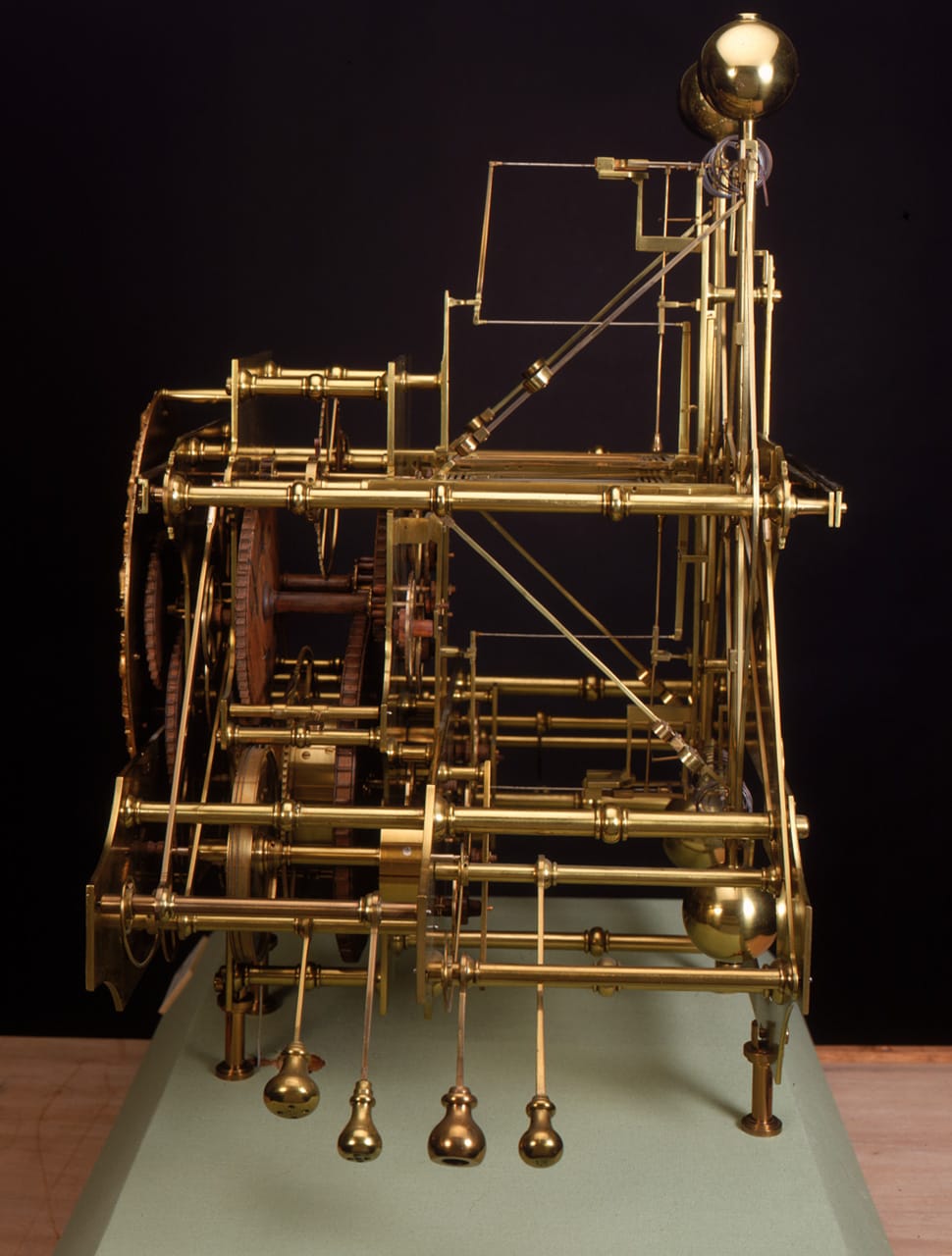
H3 consumed almost two decades of work. Its circular balances reduced some of the effects of motion, while the mechanism contained two inventions destined to outlive the clock itself: the bimetallic strip, which compensated for changes in temperature, and a caged roller bearing, the direct ancestor of countless modern bearings. Even so, H3 never achieved the required consistency.
That apparent defeat led to the decisive insight. In 1753, Harrison commissioned the watchmaker John Jeffreys to make a pocket watch to his specifications. A comparatively heavy balance, oscillating at a higher frequency and storing more energy, delivered unexpected stability. The future did not lie in shrinking a great pendulum machine, but in perfecting the heart of a portable watch.
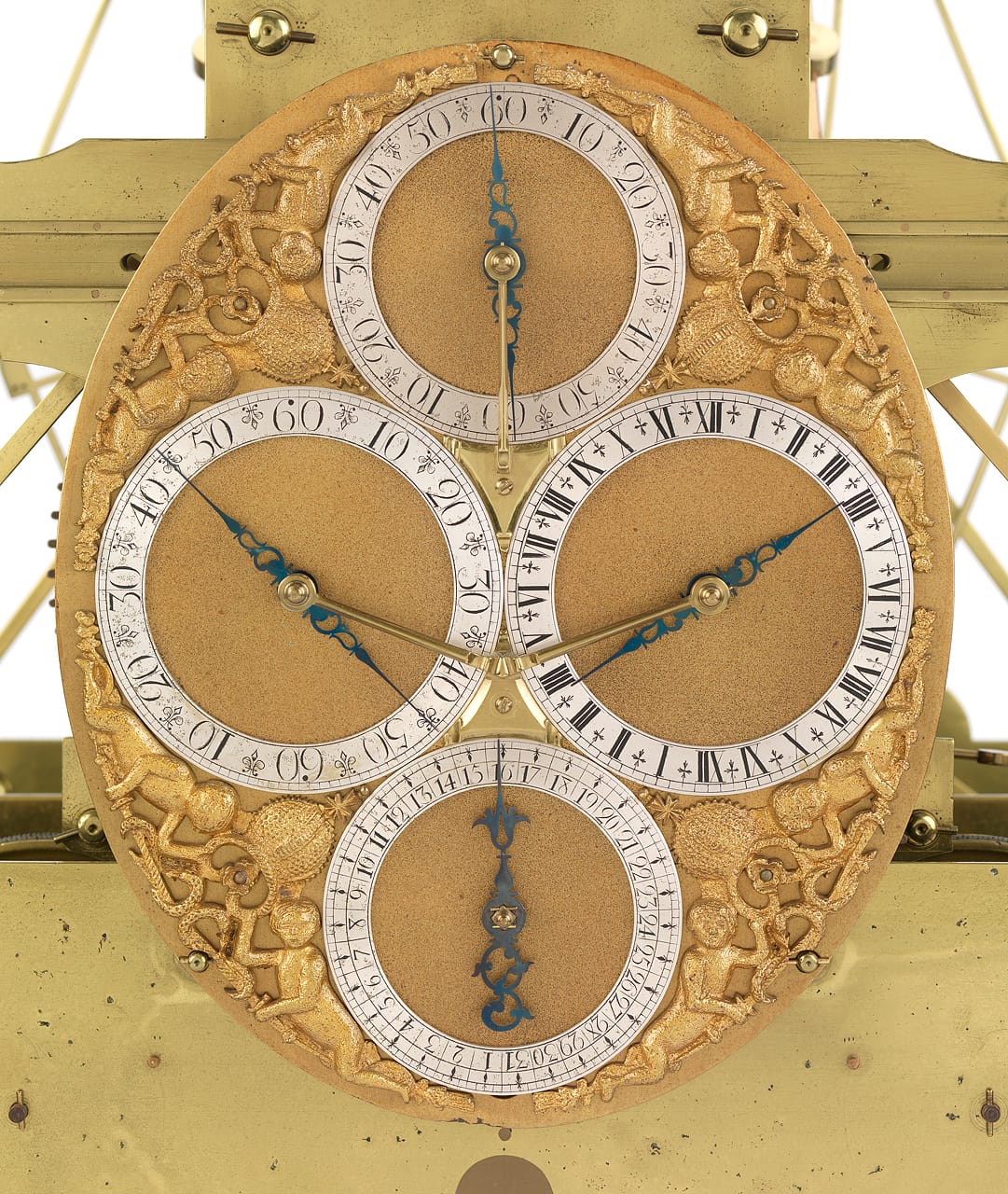
H1 Royal Museums Greenwich
H4: Precision in the Palm of a Hand
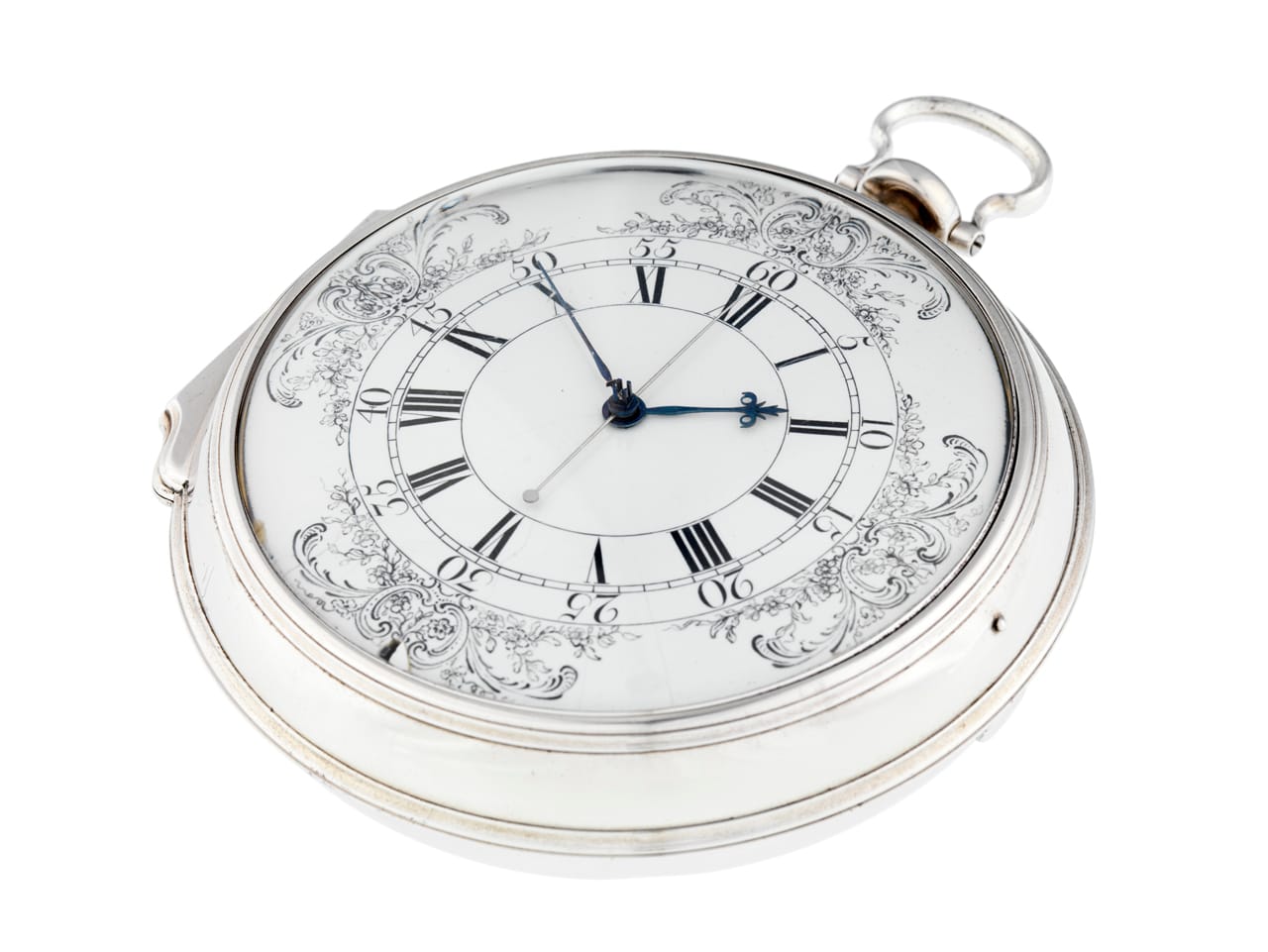
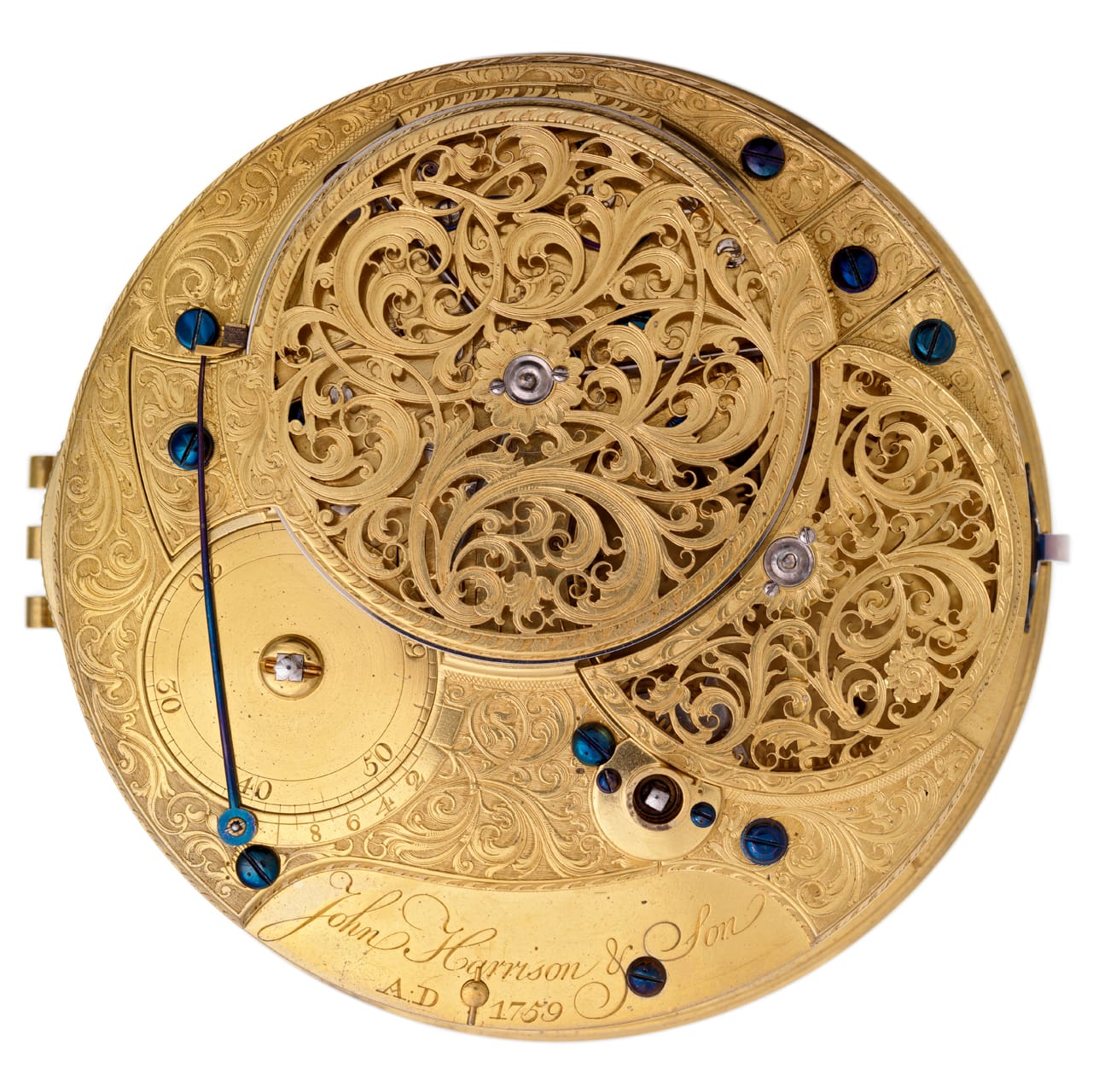
H4 was the culmination of that idea. At first glance, it resembled an oversized pocket watch, but its interior was extraordinarily sophisticated. The balance beat five times a second; a bimetallic strip compensated for temperature; the remontoire rewound every seven and a half seconds; and numerous components were mounted on rubies and diamonds to reduce friction. Even the diamond pallets of the escapement had curved surfaces produced by a method that continues to inspire admiration.
H4 conquered the ocean not through size, but through frequency: it turned stored energy into stability, and stability into position.
The watch sailed to Jamaica in 1761 in the care of William Harrison, the inventor’s son. During the voyage, it correctly predicted the arrival at Madeira despite the captain’s doubts. A second trial, to Barbados in 1764, confirmed its performance: H4 calculated longitude with an error three times smaller than the limit set by law.
Scientific victory did not bring immediate recognition. The Board of Longitude, inclined towards the astronomical method of lunar distances, demanded further demonstrations, the surrender of the machines and a complete disclosure of the mechanism. It also required another watchmaker to reproduce it. Larcum Kendall built K1, a copy of H4 that James Cook carried on his voyages through the South Seas. Initially sceptical, the navigator came to call it “our trusty friend, the watch.”
Harrison, now elderly and with failing eyesight, still had to build H5. The watch was tested at George III’s private observatory, and the King’s intervention helped bring the matter before Parliament. Harrison finally received the remainder of the reward, although he never enjoyed the unequivocal acclaim his achievement deserved.
The Measure of a Legacy
Harrison’s machines proved that longitude could be determined with a chronometer, but H4 and K1 were too complex and expensive to become widely available. John Arnold and Thomas Earnshaw later simplified the design and transformed it into a reproducible instrument fit for commerce. Through that evolution, the marine chronometer accompanied merchant and naval vessels for almost two centuries, saved innumerable lives and sustained the expansion of global navigation.
John Harrison died on 24 March 1776, the day he turned eighty-three. His legacy is not confined to an exceptional object preserved at Greenwich. It lives in the bimetallic strip, the roller bearing and, above all, in a way of understanding innovation: observe patiently, distrust what is considered inevitable and refine a solution until matter obeys an idea.
There is something profoundly contemporary in his story. Harrison did not belong to the academic centre of his age, nor did he speak the language of its institutions. He was a craftsman who thought with his hands, and an engineer before the word defined a profession. Faced with a problem that had defeated scientists, navigators and governments, he built an answer. He did not make the sea any less immense; he made it possible to know where we were within it.
Written by

Subscribe to our newsletter
Subscribe to our newsletter to get the latest updates and news