Jonas Pettersson — Woodworker
A portrait of a woodworker whose practice is shaped by patience, proportion and a deep respect for the living character of wood.

Wood has a memory of growth.
Its lines are not decorative. They are records of time, climate, pressure, resistance and renewal. In the work of Jonas Pettersson, this memory is never hidden. It becomes the starting point of the object.
Jonas is a woodworker whose practice moves between functional design and quiet sculpture. His pieces are often simple at first glance: a chair, a small table, a carved vessel, a shelf, a tool handle, a stool. But their simplicity is not immediate. It is the result of restraint, proportion and a long process of removing what is unnecessary.
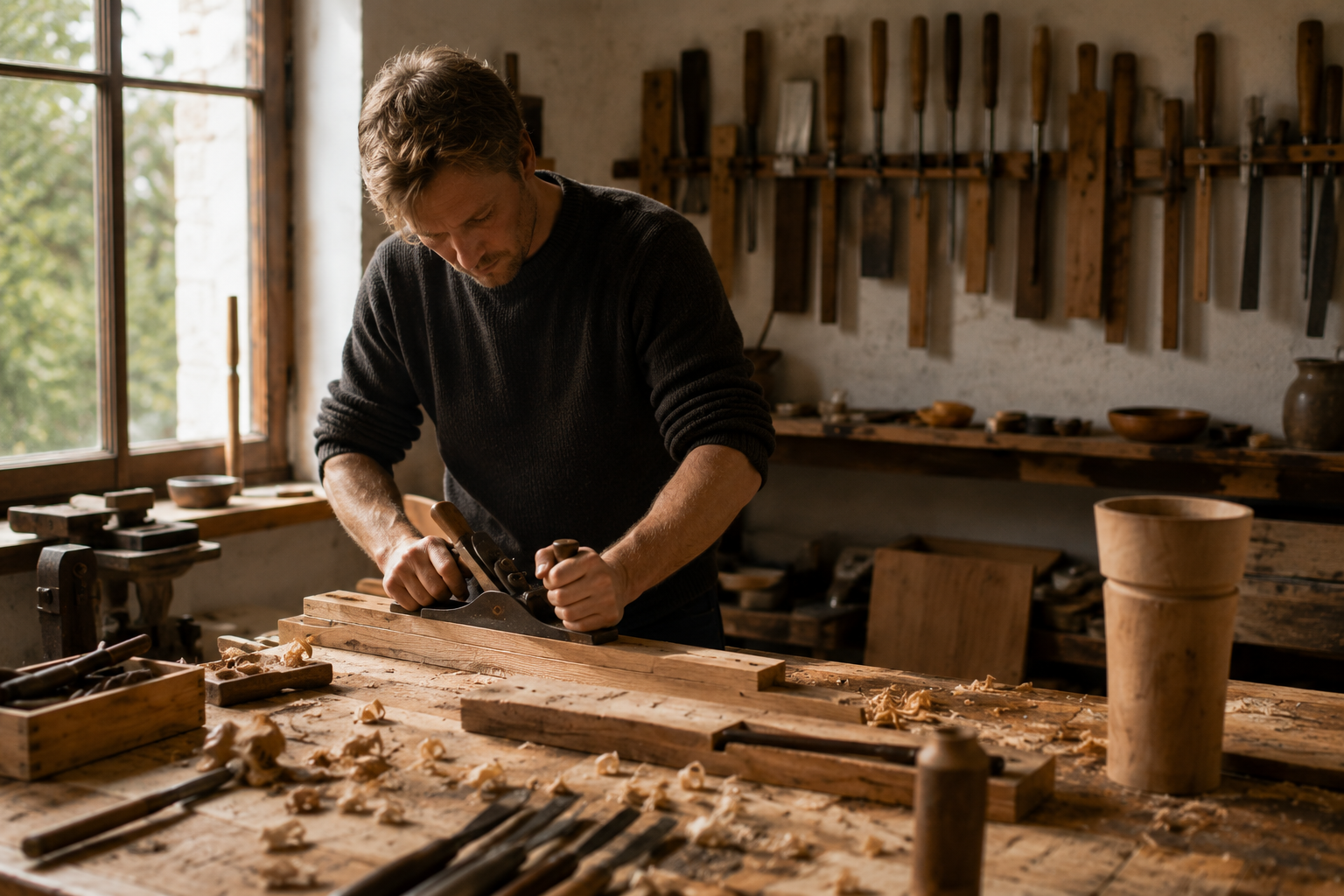
His workshop is organised around material rather than display. Planks of oak, ash, walnut and pine rest against the wall. Hand tools hang within reach. Offcuts are kept, not discarded, because even the smallest fragment can reveal a curve, a joint or a future use.
For Jonas, working with wood begins with looking.
He studies the grain before drawing a line. He reads the direction of the fibres, the density of the piece, the knots, the colour shifts and the imperfections that might either weaken the structure or give the object character.
“Wood tells you what it can become if you are willing to listen before cutting.”
This sentence says much about his practice. Jonas does not approach wood as a neutral material waiting to be shaped. He approaches it as something already carrying direction, history and force.
The discipline of woodworking is often misunderstood as a purely technical craft. It is technical, of course. A poorly made joint will not last. A surface finished too quickly will reveal impatience. A proportion slightly wrong can change the entire feeling of an object. But beyond technique, there is judgement.
Where should the hand intervene? Where should the material be left alone? When does a mark become a flaw, and when does it become part of the object’s presence?
Jonas’s pieces do not seek perfection in the industrial sense. They seek clarity. A chair should support the body. A table should hold space. A vessel should invite touch. A shelf should carry weight without drawing attention to itself.
This attention to use is central to his work. He believes that an object becomes complete only when it enters daily life. Wood changes with use. It darkens, softens, gathers small marks and absorbs the gestures of those who live with it.
In that sense, his work does not end in the workshop. It continues in the home, in the hand, in the slow accumulation of contact.
Atelia Circle is drawn to Jonas Pettersson’s practice because it reminds us that making can be both humble and exacting. His work does not announce itself loudly. It asks to be lived with, touched and understood over time.
In his hands, wood becomes more than a material. It becomes a quiet argument for durability, attention and the beauty of essential forms.
Maker Details
Maker
Jonas Pettersson
Discipline
Woodwork
Location
Copenhagen
Materials
Oak, ash, walnut, pine, natural oils, hand tools
Practice
Functional objects, furniture, carved forms, small sculptural pieces
Keywords
Wood, proportion, durability, restraint, function
Written by

Subscribe to our newsletter
Subscribe to our newsletter to get the latest updates and news