Marquetry: Patience Transformed into Quiet Luxury


Some arts do not impose themselves at first glance; instead, they invite us to come closer. Marquetry belongs to that family of crafts that demands time: time to observe, to cut, to fit, and to understand that beauty can emerge from an almost microscopic sequence of gestures. In an age dominated by speed, marquetry brings us back to a profoundly contemporary idea of luxury: not ostentation, but permanence.
The technique consists of decorating surfaces — especially wood — by inlaying small pieces of noble materials: woods of different tones, mother-of-pearl, bone, historical ivory, hard stones, metals, or glass pastes. In its most refined form, each fragment is cut, adjusted, and placed according to a preliminary design, until geometric, vegetal, architectural, or figurative motifs take shape. The result is not merely decoration applied to an object, but a skin constructed piece by piece.
Marquetry has many geographies. In Europe, it reached moments of great sophistication during the Italian Renaissance, particularly in the studioli: spaces of study and representation where perspective, simulated architecture, and humanist motifs were translated into wood. The celebrated studiolo of Federico da Montefeltro in Urbino is one of the most emblematic examples of this tradition: a room where marquetry does not simply adorn, but constructs an intellectual vision of the world.
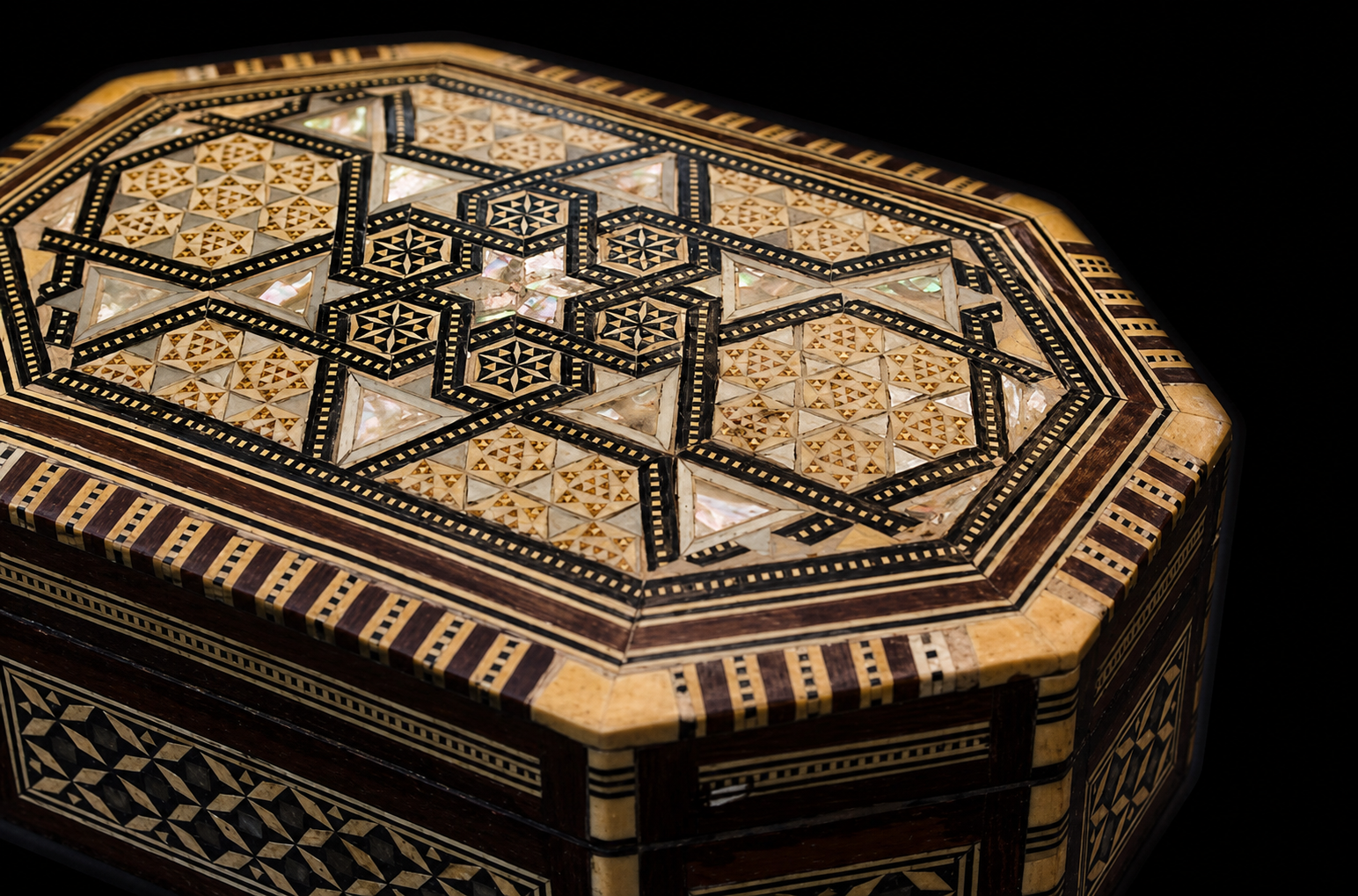
Yet the history of marquetry cannot be understood without looking toward the Middle East. In cities such as Damascus, Cairo, and Aleppo, the inlay of mother-of-pearl and bone into wood has formed part of a material culture deeply connected to domestic architecture, ceremonial furniture, and everyday objects. In the Damascene tradition, walnut wood, mother-of-pearl, camel bone, and other decorative woods are combined to create furniture, boxes, trays, game boards, mirrors, and panels of unmistakable luminosity.
What is fascinating about this technique is that it turns the fragment into a whole. Each piece, however small, only finds meaning when it takes its place beside the others. There is a powerful metaphor in this: beauty does not emerge from isolation, but from the relationship between parts. Perhaps that is why marquetry has survived so many changes in taste. It speaks a language that depends not only on fashion, but on patience, proportion, and the human hand.
In the Middle East, this art remains alive thanks to workshops, galleries, and artisans who have brought the craft into the present. Meraas Gallery, in Doha, works with handcrafted pieces of khatam, fine marquetry, and hand painting, offering backgammon and chess boards with mother-of-pearl inlays and tazhib designs, bringing together the playful object and the decorative tradition.
Also noteworthy are initiatives such as Damascus Box, which presents pieces of Damascene mosaic with mother-of-pearl inlays and highlights work associated with master artisan Gaby Al Dayeh, keeping a Syrian craft tradition visible in dialogue with the international market.
The continuity of the craft can also be seen in projects such as Al Khayat Fine Art Furniture, focused on Syrian furniture with mother-of-pearl inlays, as well as in platforms dedicated to preserving and promoting the decorative arts of the region. These initiatives insist on something essential: marquetry is not merely a decorative product, but a cultural narrative made of materials, memory, and generational transmission.
In today’s context of design and luxury, marquetry occupies a particularly interesting place. Against mass production, it introduces variation. Against the flawless industrial finish, it offers the trace of the hand. Against fast consumption, it proposes objects that aspire to endure. A box, a desk, a game board, or a marquetry panel are not only beautiful pieces; they are material archives of a way of working.
There is also an ethical dimension to its revival. To speak of marquetry today is to speak of the preservation of crafts, artisanal economies, and the need to protect forms of knowledge that often survive in fragile contexts. In Syria, Lebanon, Egypt, or Qatar, many of these practices depend on family workshops, networks of masters and apprentices, and galleries capable of connecting local tradition with international audiences.
Marquetry reminds us that true luxury does not always shine in an obvious way. Sometimes it hides in a perfectly adjusted line, in a hand-cut piece of mother-of-pearl, in wood that changes tone with the light. It is an art of precision, but also of emotion: a sensitive geometry.
In an age of replaceable objects, marquetry defends another idea of value. Not that of immediate price, but that of permanence. Not that of constant novelty, but that of inherited skill. And perhaps for that reason, when we contemplate a marquetry piece, we feel that we are not merely looking at a decorated surface, but at a form of resistance: slow beauty in the face of an accelerated world.
Written by

Subscribe to our newsletter
Subscribe to our newsletter to get the latest updates and news