The Light of the North: Three Ways of Looking at Denmark

From the silence of Copenhagen interiors to the long, open beaches of Skagen, Krøyer, Ancher and Hammershøi turned light into something unusual—something more than a pictorial device. They made it atmosphere, time and state of mind. Light, after all, behaves differently from one place to another.
In Denmark, it became part of a pictorial identity, the basis of a new artistic current. By the late nineteenth century, a number of painters had begun to look closely at things that seemed almost impossible to hold onto: the glow of a summer evening, sunlight entering through the window of a dark room, the dampness left behind after a storm.
Peder Severin Krøyer, Michael Ancher and Vilhelm Hammershøi worked in very different settings. The first two found in Skagen a place where sea, sky and people seemed to share the same light. Hammershøi, by contrast, turned inward, towards enclosed spaces—the empty rooms of old Copenhagen apartments, where light was allowed to enter quietly through a window.
What is striking is that what should have remained secondary becomes the true subject. The scene recedes. Atmosphere takes over.
Skagen: painting where the land ends
In Skagen, at the northern tip of the Jutland peninsula, an artistic movement emerged around figures such as Michael Ancher, Viggo Johansen, Carl Locher and Peder Severin Krøyer. It is not difficult to understand the attraction.
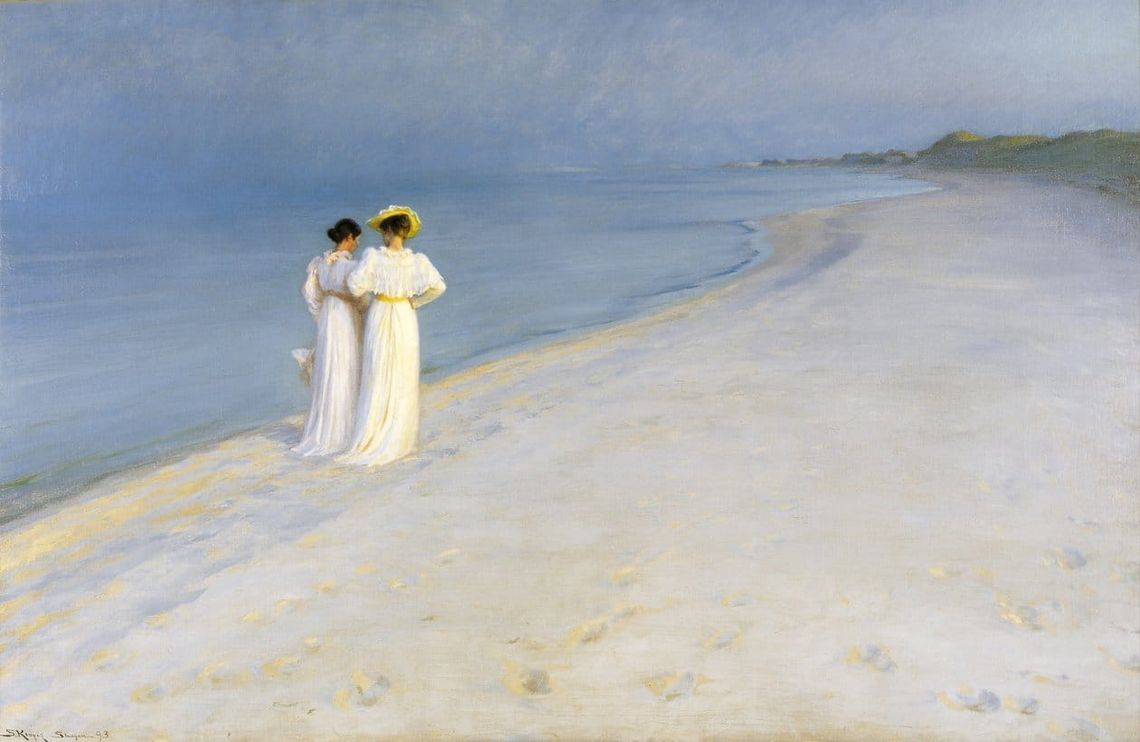
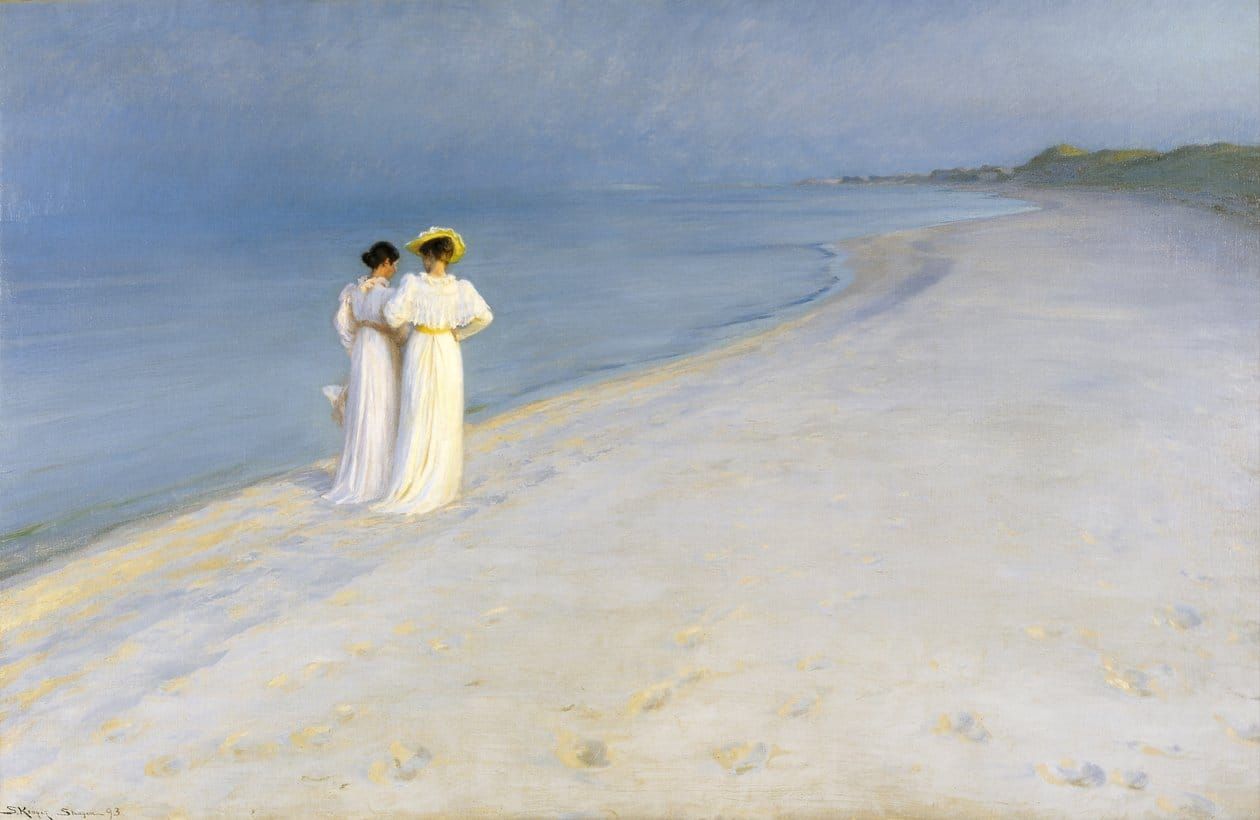
The horizon dominates everything. Long stretches of pale sand meet a sky whose brightness constantly alters the colour of the sea. Krøyer made this quality one of his signatures. A clear example is Summer Evening on Skagen’s Southern Beach, painted in 1893, in which two women walk along the shoreline. They were the wives of Krøyer and Ancher, both painters themselves. The work unfolds through a broad range of blues, with sea and sky almost dissolving into one another, while the sand stands out in its pale, almost white tonality.
The strength of the painting does not lie in the scene itself, but in the attempt to capture a particular hour of the day.
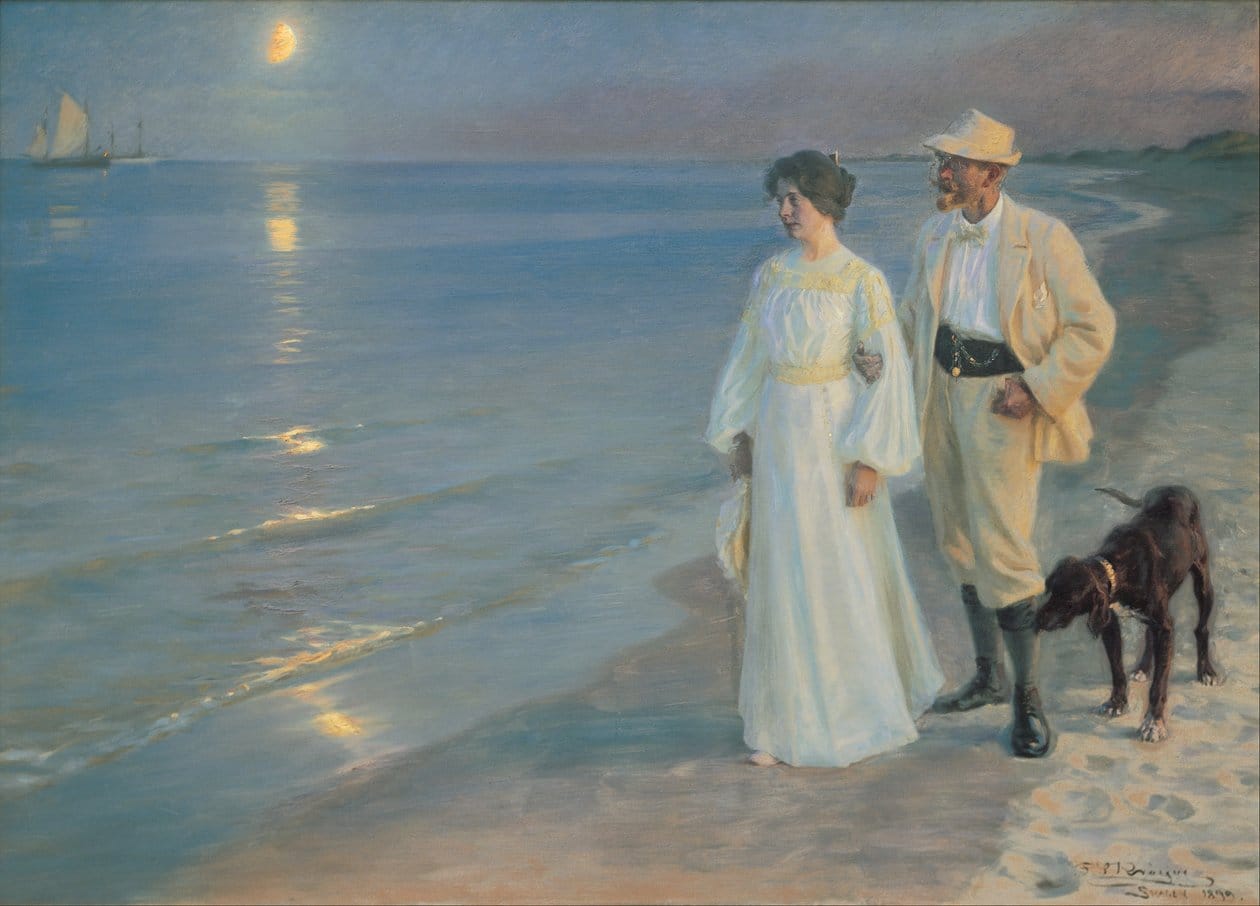
Another example can be found in Summer Evening at Skagen, dated 1899, an oil painting now in the Hirschsprung Collection in Copenhagen. In it, the moon is reflected across the water as two figures walk along the beach accompanied by a dog. Once again, blue dominates the composition.
Six years separate the two works, yet the obsession appears to be the same: to capture the moment when the sun begins to disappear.
Michael Ancher: when the sea ceases to be landscape
For Michael Ancher, the sea changes meaning. It becomes work, danger, waiting.
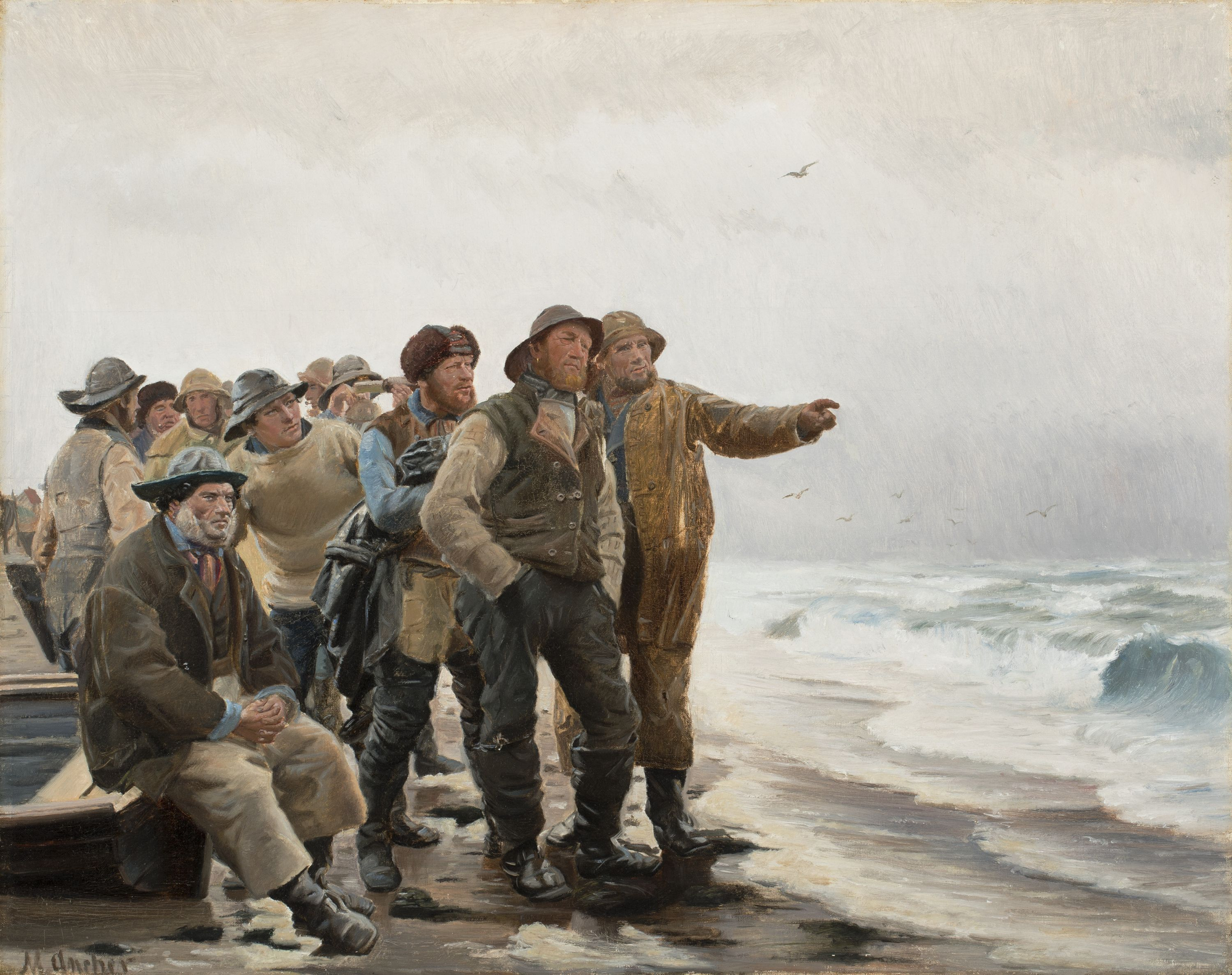
In Vil han klare pynten, painted in 1880 and now held by the Statens Museum for Kunst in Copenhagen, a group of fishermen watches a vessel struggling in the distance. The expressions of the men at the front can be read clearly, while those further back become less distinct. Ancher renders the northern light with remarkable force on a stormy day, combining blue-grey tones with greys in the sand to convey the sensation of wetness.
This composition marked an important step for Ancher. It was not painted directly on the beach, but developed from a series of studies. It also represented a considerable investment. The painting was not monumental in scale, yet for a young artist with limited means it was expensive to produce once the cost of models, canvas, paint, easel, frame and transport were taken into account. In terms of both materials and time, it was at least four times more costly than many of the smaller plein-air works produced in Skagen.
It was still a period in which the income from a single painting could sustain an artist for years. For many Danish painters, it was common practice to produce at least one large, ambitious work for the annual exhibition, then one of the most effective ways of gaining recognition.
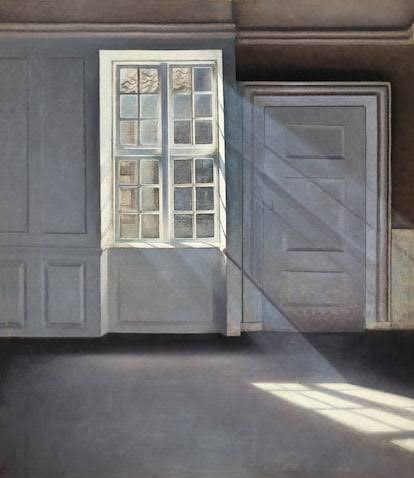
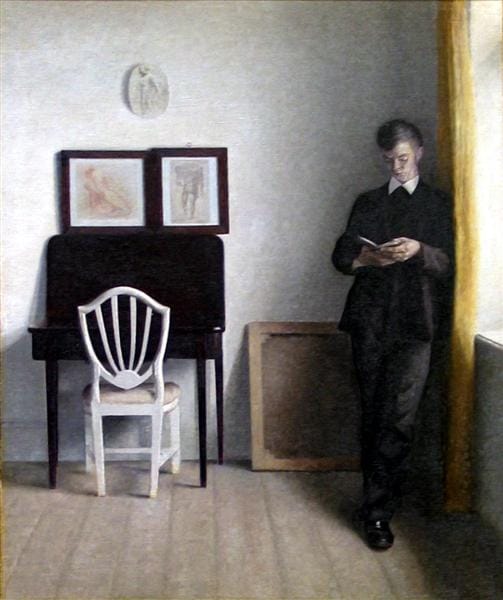
Vilhelm Hammershøi - Rays of Sun - 1900 / Interior with man reading - 1898
Hammershøi: closing the door on the world
With Vilhelm Hammershøi, we leave the beach and enter a room.
The shift is radical. Where Krøyer needs the horizon, Hammershøi needs walls. Where Ancher gathers a group of men before the sea, Hammershøi strips the scene of almost every human presence.
In the work known as Sunbeams, later also referred to as Dust Motes Dancing in the Sunbeams, the composition is reduced to a handful of elements: a window, a door, a floor and a shaft of light. Nothing happens. And yet everything does.
The painting was greatly admired for Hammershøi’s ability to suggest dust moving through sunlight. But another detail is equally significant: the elements that would normally connect the room with the outside world almost disappear. The window fittings are absent, the door hinges cannot be seen, and the panes of glass appear almost opaque. The implication is clear: the outside world exists, but it remains unreachable. The light enters. The world does not.
There is a paradox here. The very thing that should connect us with the exterior instead creates a sense of isolation.
In Interior with a Young Man Reading, dated 1898, the same idea continues. A man stands reading at one side of the composition while light enters through the window, touches his face and hand, and then falls across the wall behind him.
The figure does not occupy the physical centre of the painting, yet he remains its emotional centre. The emptiness surrounding him is not absence. It is part of the subject.
The link between these artists lies in three different ways of seeing light. Krøyer looks outward and finds a light that stretches into the distance until it almost erases the horizon. Hammershøi turns inward, reducing the world to an empty room in which a single shaft of light is enough to create an entire atmosphere. For Ancher, observation becomes something else: men dependent on the sea, danger, dampness, effort.
In none of these cases is light merely illumination. For Krøyer, it is a fleeting moment. For Ancher, it is human coordination and weather. For Hammershøi, it is silence. Because looking does not always mean finding something extraordinary. Sometimes it simply means remaining long enough before something everyone else has overlooked.
Written by

Subscribe to our newsletter
Subscribe to our newsletter to get the latest updates and news